
Performance
Where
Stari Grad
When
Thu Nov 12
Ages
6+
A stage play of the classic fairy tale of Thumbelina, the tiny girl, performed at Pozorište Boško Buha.
It is performed in Serbian, so it suits school-age kids who follow spoken Serbian.
Stari Grad is the old heart of the city, and it packs a lot into a short walk. Kids can climb around the fortress walls at Kalemegdan, burn off energy on park playgrounds and duck into a museum when the weather turns. Kids' theater, workshops and festivals fill the calendar through the year, and this list updates as new ones are announced.
A stage play of the classic fairy tale of Thumbelina, the tiny girl, performed at Pozorište Boško Buha.
It is performed in Serbian, so it suits school-age kids who follow spoken Serbian.
A series of four linked workshops at Evropska kuća Beograd where kids go from an idea to a finished book of their own. They invent a hero and write a short story, illustrate it and design a cover, read a book together, then put it all into a small book or zine.
It suits kids who like drawing and making up stories, and who speak Serbian.
A rock musical about good against evil, with a princess, a hero, an empress, a witch, a villain and a court jester. Live actors perform in front of a projected storybook screen while rock songs carry the plot. The story asks what is true, whether love beats fear, and whether evil can be beaten. Good wins, but only after a fight, so it suits kids who can handle a villain and loud music.
Lepenski Vir is a site of early prehistory that is, in many ways, unique. This workshop at the National Museum of Serbia introduces kids to it: what its sculptures stood for, how its people lived and what kind of houses they built.
It suits kids curious about archaeology and the distant past who are comfortable following a session in Serbian.
Dragan Karolić's children's opera tells the story of Snow White, the jealous queen, the magic mirror and the poisoned apple, sung to a live orchestra. Seven dwarfs, a singing mirror and a wedding finale keep it moving.
It suits kids who already know the fairy tale and can sit through a short show in a theater.
A touring ice show that tells Alice in Wonderland on skates. Alice, the Mad Hatter, the Queen of Hearts and a furry Cheshire Cat skate the story to music, joined by a giant inflatable caterpillar, an aerial hoop act and big video projections across the backdrop. It suits kids who already know the story and can sit through a full evening show.
A public sports center in Dorćol with three outdoor pools for summer: a 2 m deep Olympic pool, a 1.2 m recreational pool with a mushroom fountain, wall and central geysers, and a kids' pool 20 cm deep with a rubber floor. From September to June the indoor 50 m Olympic pool opens for public sessions. A small 30° pool hosts the swim school.
A creative playground beside the Cvijeta Zuzorić Art Pavilion, on the eastern side of Kalemegdan Park where the fortress grounds meet the city streets. Its centerpiece is a big rope climbing net strung across a wooden frame, over soft wood-chip ground. It opened in 2015, built to European safety standards with a modern design. The Belgrade Zoo takes up the northern end of Mali Kalemegdan, a short walk away.
Jevremovac is a botanical garden run by the Institute of Botany, with more than 1,300 plant species outdoors. Its centerpiece is a Victorian glass greenhouse from 1892, with rainforest plants under the dome and desert succulents in the north wing.
Outside, paths lead past a Japanese garden with stepping stones over water, a water lily pool, a bamboo maze, a children's corner and oaks more than 140 years old.
Pionirski Park is a 3.6-hectare former royal garden set between the Old Palace, now the City Assembly, and the New Palace, now the President's office. The side along Kneza Miloša has the most lawn and the finest old trees, with panels naming giant specimens such as an English oak, a ginkgo and a horse chestnut. Toward Kralja Milana there is a fountain with flowerbeds.
Džumbus is a playroom and café inside the Milan Gale Muškatirović sports center in Dorćol, a short walk from the Danube. Kids climb frames, swing on vines and race down slides past big elephant figures, then move on to kids' arcade games and a large play castle in the garden.
Animators run games, craft workshops and treasure hunts and keep an eye on the kids.
A city-run arts center for children, founded in 1952 as the Dom pionira and at Takovska 8 since 1968. Inside are studios for painting, comics, printmaking and animation, rooms for ballet, singing and acting, a children's choir, and a stage for kids' and teen shows.
Most programs are workshops kids sign up for, and one theater workshop runs in English. The center also organizes the Radost Evrope children's festival.
MTS Dvorana is the restored hall of the Dom sindikata building on Nikola Pašić Square, where the first FEST film festival took place in 1971. It now runs five cinema screens alongside a large concert hall. The film program mixes new releases with animated family films, and the first floor has a 150 m² party room with arcade games for kids' birthdays.
A guided sightseeing cruise on the Sava and the Danube, boarding at Beton Hala below the old town. The boat passes Kalemegdan Fortress and Nebojša Tower, heads out to the confluence with views of Great War Island and Zemun, then runs upriver past Belgrade Waterfront and under the Branko, Gazela and Ada bridges.
Guides on the daytime cruise speak English. The club also runs sunset and dinner cruises.
The planetarium is a star theater under an 8-meter dome, run by the Ruđer Bošković Astronomical Society, the oldest astronomy society in the Balkans. A guide projects the night sky and talks through constellations, the Moon, planets, stars and galaxies, then shows how the sky shifts through the day and the year and from different places on Earth. It suits kids who can sit through a lesson-length talk.
An outdoor park of life-size dinosaur models in Mali Kalemegdan, next to the Belgrade Fortress. Kids walk the paths between the models, then let off steam at the on-site playground.
An open-air cafe serves drinks for parents, and a souvenir shop sells toys and keepsakes. The park also hosts birthday parties, with food, drinks, decoration and music organized by the team.
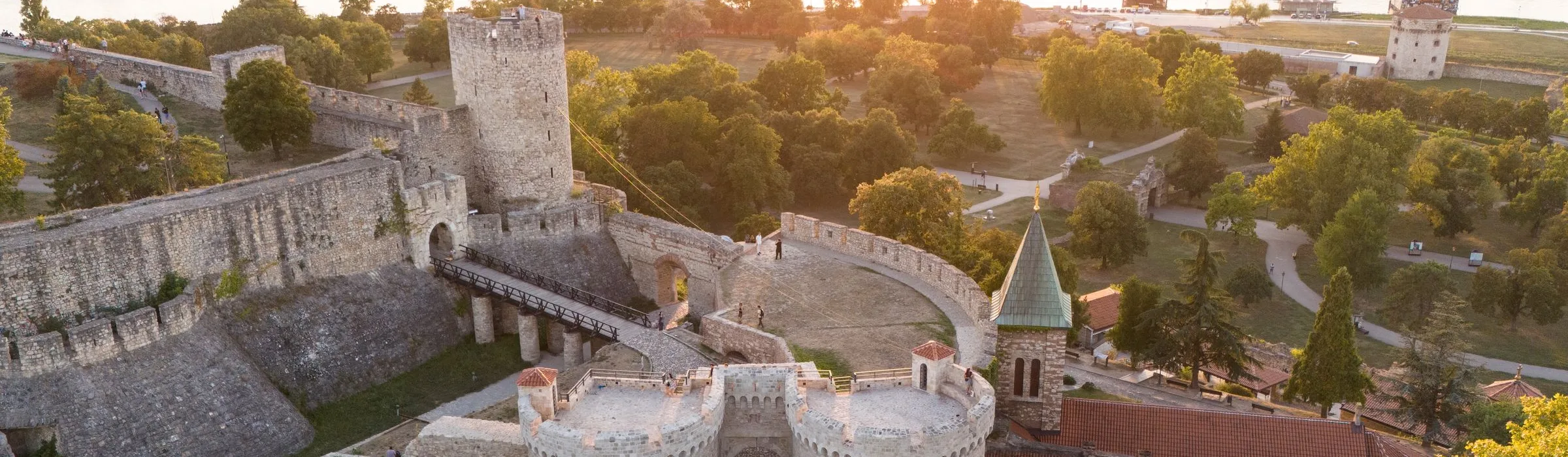
Belgrade Fortress sits on a ridge where the Sava meets the Danube, with Kalemegdan Park wrapped around its walls. Kids can walk the ramparts and old gates, find the Victor monument and the fortress cannon, and go down into the Roman Well, a military bunker or the Nebojša Tower.
The park side has two open playgrounds, a Dino park and the Belgrade Zoo, plus basketball and tennis courts.
Belgrade Zoo fills about 7 hectares inside Kalemegdan Fortress park and keeps around 200 species. Kids look for the white lions and white tigers, watch the penguins in their 2019 enclosure, and find Muja, an American alligator that has lived here since 1937.
A petting zoo has alpacas, rabbits and pygmy goats, and two cafés and ice cream stands sit inside the grounds.
While its permanent exhibition is being prepared, the museum shows a selection from its 50,000 objects. On show are King Peter I's coronation globe, scepter, cloak and crown, the only preserved Serbian crown, cast from the iron of a cannon from Karađorđe's uprising. Five reconstructed crowns of medieval rulers, Emperor Dušan's among them, are shown for the first time. It suits school-age kids curious about kings and crowns.
Belgrade's largest and oldest museum, founded in 1844, fills three floors and 5,000 square meters with a permanent collection running from the Paleolithic to 20th-century art.
Kids can look for prehistoric sculptures from Vinča and Lepenski Vir, some over 8,000 years old, then hunt down paintings by Renoir, Monet and Van Gogh. Its treasures include the Miroslav Gospels, an illustrated manuscript from 1186.
The Ethnographic Museum shows how people across Serbia lived in the 19th and 20th centuries. The permanent exhibition has typical houses from different regions, town interiors, festive displays, traditional clothing and farm tools.
A Children's Corner hosts the museum's "Child and Tradition" workshops year-round, from wax-resist Easter egg decorating to wool felting. Traditional costumes and jewelry fill a second building, Manak's House.
The Military Museum sits on a bastion of the Belgrade Fortress at Kalemegdan. Inside, more than 3,000 objects fill 52 rooms: weapons, uniforms, flags and medals tracing Serbian military history from the medieval states to the wars of the 1990s.
Outside, cannons, tanks and armored vehicles from Germany, Italy, Russia, the USA and more stand around the building, including the only surviving Polish TK-3 tankette.
A hands-on illusion museum on three levels, where most exhibits are meant to be touched and photographed. Kids walk the spinning Vortex Tunnel, shrink and grow in the Ames room, pose in an upside-down room and play poker with five of their own clones.
Inside the exhibition, a puzzle playroom has wooden Dilemma games for kids to work through between rooms.
The Natural History Museum shows its collections here, in a small 19th-century Ottoman-style guardhouse on Mali Kalemegdan that once guarded the main approach to the fortress from Stambol Gate. Exhibitions rotate, around 60 since it opened in 1994, each on a different chapter of natural history.
Curators run talks and kids' workshops alongside each exhibition, the Green Salon side room holds mini shows, and a shop sells nature souvenirs.
The museum fills the 1928 building of Serbia's first public power station, in Dorćol. On the ground floor, a science playroom lets kids feel centrifugal force, test their balance and puzzle over optical illusions, and a toy gallery shows over 150 toys from 1920 to 1970 at kid height.
The Aleksandar Despić gallery holds 400-plus objects, from steamships and old printing to the first Serbian-made computers and Tesla's induction motor.