
A family visit-workshop at CaixaForum Palma built around the work of two painters, Zuloaga and Anglada-Camarasa. Kids look at the exhibition, then move on to a hands-on workshop.
It suits school-age kids who like art and making things.

Somewhere around eight, the playground stops being enough. Kids this age want the full version: a proper stage show, a festival they'll talk about for weeks, old stones they can climb through with a story attached. These are the plans across the island that suit kids aged 8 to 12, and the list updates itself as new ones are added.
A family visit-workshop at CaixaForum Palma built around the work of two painters, Zuloaga and Anglada-Camarasa. Kids look at the exhibition, then move on to a hands-on workshop.
It suits school-age kids who like art and making things.
Dickens's Christmas classic, staged in English. Ebenezer Scrooge counts every coin until his old partner, Jacob Marley, visits on Christmas Eve, and three spirits (of Christmas past, present and future) lead him through memories, laughter and shadows until he learns that sharing beats hoarding.
Kathleen Bendelack directs her own adaptation. It suits kids who follow spoken English and already know a ghost story won't keep them up at night.
Pueblo Español is an open-air museum of copies of buildings, streets and squares from across Spain, built between 1965 and 1968 to designs by architect Fernando Chueca Goitia.
Kids can walk 15 streets and 12 squares, from a copy of the Alhambra's Patio de los Arrayanes to Córdoba's Cristo de los Faroles. Craft workshops sell ceramics, textiles and blown glass, and cafés serve tapas.
A hands-on craft workshop at the neighborhood library in El Molinar, run by Kidsdays. Kids make stars and snowflakes that become Christmas decorations.
It suits school-age kids who like making things with their hands.
A Christmas craft session at the neighborhood library in Coll d'en Rabassa, run by the library staff. Kids use recycled materials and paint to make their own Christmas decorations.
It suits school-age kids who like making things with their hands. The session is led in Catalan, but the craft itself is easy to follow by watching.
A first taste of acting for a camera instead of a stage, led by Espill Teatre at a Palma public library.
Kids explore how a performance works when it's being filmed and how to build a character for the screen. It suits kids who like putting on shows or making videos and are curious about how screen acting works.
A stage musical about Hercules, a young man with superhuman strength, on an adventure that runs from Mount Olympus down to the depths of the underworld.
It suits kids who like Greek myths and hero stories, and any kid who enjoys a show full of songs.
Operación Santa is a Christmas musical for families. When the mysterious list of children goes missing, Santa Claus and his team of elves set off on an adventure to get it back before Christmas.
The story is told through songs and scenes in Spanish, so it suits kids who can follow a plot in Spanish.
Estoy Solo en Casa is a musical at Trui Teatre, listed as a show for children. The title means "I'm home alone."
It is performed in Spanish, so it suits kids who can follow songs and dialogue in Spanish. For a child who doesn't speak it yet, the story will be hard to keep up with.
A ballet version of Snow White: the pure-hearted princess, the jealous queen and her magic mirror, and the seven dwarfs who shelter her in the forest. More than 20 dancers tell the story through dance and music, with no spoken text.
That makes it an easy pick for kids who speak no Spanish or Catalan, especially if they already know the fairy tale.
One of the few pieces of Moorish architecture left on Mallorca, these 11th-century baths sit in a stately garden. The main room was the hot bath: a square hall under a dome with skylights, held up by 12 columns with horseshoe arches. Its double floor once carried hot water and steam.
A barrel-vaulted room survives next door. The site is small.
Raixa is a historic country estate run by the Consell de Mallorca. Its gardens climb a monumental staircase lined with statues to a 98-meter pond, a grotto, a small hermitage and a temple at the top, with lookouts over the house and the countryside.
Inside the house, the Centre Serra Tramuntana explains the UNESCO-listed mountain range across nine rooms.
La Almudaina is the royal palace across from Palma Cathedral, built between 1305 and 1314 for King Jaime II on the site of an Arab fortress. It is still the King of Spain's official residence when he visits Mallorca.
Kids walk through the Patio de Honor with its white marble lion, the Arab baths with their cold, warm and hot rooms, and the vast Gothic hall where ambassadors were received.
The Museu d'Art Sacre de Mallorca, formerly the Museu Diocesà, fills a wing of the Bishop's Palace next to the cathedral, in rooms renovated in 2020. Gothic paintings, carvings and silverwork come from churches and monasteries across the island.
For kids, the standouts are the Drac de na Coca, a 17th-century embalmed crocodile behind a local dragon legend, and stained glass Antoni Gaudí made for the cathedral.
Els Calderers is a historic country estate whose manor house was built from about 1750 by the noble Verí family. Kids walk through more than 30 rooms, including the music room, family chapel, kitchen and dining room.
Outside are the barns, stables and hen houses, native farm animals such as the Mallorcan black pig, and the old blacksmith's workshop, bread oven and laundry where clothes were washed and dyed.
MUCBO pairs a natural science museum with a terraced botanical garden in Sóller. Upstairs, fossils run from the oldest to the newest, ending with megalodon teeth, a life-size model of a dugong relative and a mounted Myotragus skeleton. Another floor has a life-size blue shark and a golden eagle.
Outside, terraces recreate Balearic habitats, from shady stream beds to rocky coast. Kids can borrow an explorer lab coat and map.
A municipal museum telling the story of shoemaking on Mallorca, from hand tools to the factory machines once used to make Inca's double-stitched Goodyear shoes. The permanent collection fills the first floor of a former army barracks: machinery, shoes, design drawings, photographs and old advertising, almost all donated by local firms and families. The ground floor holds temporary exhibitions.
La Seu is the Gothic cathedral on Palma's seafront, built from 1229 on the site of the city's largest mosque. Inside, kids can look up at a nave 44 meters high and one of the largest Gothic rose windows still standing, nearly 14 meters across.
Antoni Gaudí reworked the interior from 1903 and designed the canopy over the altar, and artist Miquel Barceló covered a chapel in ceramic.
The Museu de Mallorca fills Ca la Gran Cristiana, a baroque palace built on two Gothic ones in the old town. Its rooms run in date order through the island's past: prehistory, Rome, Late Antiquity, Islam, Gothic, Renaissance, baroque and modern times.
Kids can look for pre-Christian mosaics, a late-Roman columbarium, Gothic paintings and sculpture, pottery from many periods, and a room of modernist ceramics made at La Roqueta.
Pollença's traditional fair fills the old town with craft stalls, a local food and farm fair, live music and family shows. Kids can watch a blacksmith and a dry-stone wall builder at work in the old cloister, then try a craft at a workshop.
The farm side has animals, birds of prey, a rooster contest and sheepdogs herding geese. It suits families happy to wander, snack and catch a show.
Bunyola, a village at the foot of the Serra de Tramuntana, marks Santa Catalina with several days of local traditions: market stalls and crafts, the village giants, xeremiers (Mallorcan bagpipers), folk dancing and a Christmas lights switch-on.
It suits families who enjoy a busy village street scene. Some evenings lean toward grown-ups, like the rock concert and the tapas night, so with younger kids the daytime fair is the pick.
A seasonal outdoor ice rink set up in Parc de les Estacions for the winter holidays. The 420 m² main rink has room for confident skaters and for kids who spend the whole session holding on to the barrier.
Snow falls over the ice while you skate, which is a big part of the fun in a city where skating is not an everyday thing. Skate rental is included.
Circo Alegría brings its Christmas show to Palma for the first time, in a big top at Son Fusteret. Kids watch international acrobats, trapeze jumps, aerial silks, clowns and motorcyclists racing inside the Globe of Death.
The finale is Santa Claus flying over the audience in his sleigh. The acts need no Spanish, so it works for any family looking for a holiday outing.
A theater show that starts in a small craft workshop and travels into the oldest forests on Earth. Spoken storytelling, illustration and live violin carry the story along.
It's led in Catalan and leans on the spoken word, so it works best for kids who follow Catalan. Kids who like music with their stories get the most from it.
A stage musical of the Grinch story: the grumpy, lonely creature who plots to steal Christmas from the Whos of Villaquién, until little Cindy Lou shows him the holiday is more than decorations and presents.
It's a Christmas show with live music and voices, told in Spanish. It suits kids who follow Spanish and like a story with songs.
City Sightseeing runs red open-top double-decker buses on a 19-stop loop around Palma. Kids ride up top past La Seu cathedral, the Passeig Marítim seafront, Poble Espanyol and up the hill to Bellver Castle, with recorded commentary through headphones in 8 languages.
A ticket covers unlimited rides for 24 hours, so families can hop off at a sight and catch a later bus. The route doesn't go near the beaches.
A white lighthouse tower and keepers' houses on the southern tip of Mallorca, lit since 1863 and the first in Spain to run on solar power, in the 1980s. The building is closed, so the visit is the headland around it.
East of the cape, cliffs. To the west the coast stays low and rocky, with seawater pools, wind-twisted junipers and small beaches toward Colònia de Sant Jordi.
A prehistoric cemetery on the shoreline, where 109 stone tombs built between the 7th and 1st centuries BC still stand. Many copy the round and ship-shaped buildings of Mallorca's Talayotic villages, so the site looks like a town in miniature.
It sits inside Son Real, a 395-hectare public estate with marked walking paths, pine-shaded picnic tables and an interpretation center on old farm life and the finds.
Finca Pública Galatzó is a 1,400-hectare mountain estate in the Serra de Tramuntana, owned by Calvià council since 2006. Eight marked trails cross it, several starting at the old possessió houses, with their oil mill, chapel and botanical garden.
The easy Sa Vinya walk passes stone terraces, a bread oven and Talayotic remains. Mallorcan goats roam the slopes, and the peak above carries the legend of the Comte Mal.
Valldemossa is a stone village in the Serra de Tramuntana mountains, built around the Royal Charterhouse. Inside the former monastery, kids can walk the long arched corridor of monks' cells, see the piano Chopin played in the winter of 1838-39, peek into an old pharmacy and look over the valley from the gardens. Outside, flower pots line the stone facades of the lanes.
Alcúdia's old town sits inside a 14th-century wall, and kids can climb up and walk along it almost all the way around. Just outside the walls lie the ruins of Pollentia, the most important Roman city in the Balearic Islands. Paths lead past the Portella houses and their columned street, the forum with its temples, and a theater cut into the rock.
Reserva Park is a protected forest in the Serra de Tramuntana, crossed by a 3.5 km trail past caves, waterfalls and mountain views. Along the way, a rescue project houses animals that were in trouble or due to be put down, including two bears, Xaloc and Tramuntana, and eagles.
Kids can feed some of them, and in summer the natural pools with waterfalls open for swimming.
Can Prunera is a 1911 Art Nouveau house with stained-glass windows, a spiral staircase, hydraulic tiles and original carved furniture. Its rooms hold paintings by 19th- and 20th-century masters, and the garden has sculptures among the trees.
For kids, the pull is the Playground: 450 m² of hands-on installations inspired by Joan Miró, built from color, light and shapes that change as visitors move and build with them.
The island's maritime museum fills five halls of the Ses Voltes cultural center. Kids can look at naval models, never-before-shown finds from underwater archaeological sites and objects from traditional seafaring trades, with videos and interactive displays on marine biodiversity and the island's sea cooking.
There is also an educational space, and temporary shows such as Atlàntides, on myth and rising seas.
Nine themed rooms built for play and photos, upstairs off Plaça Major in the old town. Kids jump into a ball pit of 20,000 balls, lie under 2.5 million stars, cross a laser maze, chase their colored shadows and draw in Mallorca sand. Mirror rooms and a Pink Gravity Room, where balls seem to roll uphill, round it out. A photo booth prints shots on the spot.
FoKO is an interactive gallery of more than 15 different rooms where visitors play, touch, dance and paint as they go. Families move through in small timed groups of up to six, at around five minutes per room, and the spaces are built for taking photos. A full visit takes about an hour.
CaixaForum Palma is the Fundación "la Caixa" cultural center in the former Gran Hotel, a 1903 Modernista building by Lluís Domènech i Montaner, with glazed tiles, wrought iron and floral capitals on its facade.
Inside, a permanent collection of the painter Hermen Anglada-Camarasa sits alongside changing exhibitions, which have included Disney and Pixar shows. The program adds family visits, workshops, concerts and films.
Palma Jump is an indoor trampoline park in the Son Valentí business park, fully renovated for its reopening. Kids bounce across open trampoline courts, launch onto a giant airbag, and work through a Ninja Warrior course and a parkour zone. Slacklines, a slam dunk lane, slides and interactive games fill out the rest of the park. There is a café on site, plus code lockers for bags and phones.
The Betlem de Cort is the traditional nativity scene set up each Christmas in the entrance hall of Palma's City Hall. Betlem is the Mallorcan word for a nativity scene, and visiting it is a yearly habit for many local families.
Kids get up close to miniature landscapes, characters and small details that tell the Christmas story. It makes an easy stop on a walk through the old town.
Palma's Christmas season centers this year on Parc de Nadal, a Christmas market in Parc de la Mar, across from the Cathedral. Kids can skate on the ice rink, follow a gimcana in search of the Set Guardians for prizes, and wander 60 stalls of seasonal food, local workshops and Mallorcan crafts.
Beyond the park, the lights reach more streets and neighborhoods than before, good for an evening walk.
A village fair in Mancor de la Vall, at the foot of the Serra de Tramuntana, built around the esclata-sang, a prized wild mushroom from Mallorca's forests. Six spots around the village serve mushroom dishes.
Kids get workshops, a play area and animals to meet, a Cucorba show, a parade of giants and Mallorcan bagpipers. The late-night correfoc brings fire, drums and dancing devils to the streets.
A stage musical built around K-Pop, telling a theatrical story through songs and spoken scenes. It is billed for all audiences, with a special pull for young people, families and K-Pop fans.
It suits school-age kids and teens who already know the music. Since the words carry the plot, it works best for kids who can follow the dialogue.
Palma's Cavalcada de Reis is the city's Three Kings parade. Melchior, Gaspar and Balthazar arrive.
It happens around the Moll Vell, the old harbor pier, and it suits kids who still believe in the Kings.
Mallorca's most important local festivities, built around fire and demons. For Sant Antoni, patron saint of animals, towns across the island light foguerons (bonfires) and dimonis (demons) take center stage.
In Palma, the week before the feast of Sant Sebastià, the city's patron saint, fills with music and activities for all ages, with a festive night of concerts in the squares and bonfires where people toast local produce.
Ermita de Betlem is a hermitage founded in 1805, about 280m up in the hills above Artà and reached along a lane of cypresses. Its modest church has a sundial and rose window outside and a frescoed ceiling inside.
Behind it, a short path climbs to Sa Coassa, a World War II plane-spotting post whose barracks walls are painted with aircraft. The view takes in the Bay of Alcúdia.
Puig de Randa is a 543-meter hill near Algaida, reached by a narrow 5km road or on foot from Randa village. On the way up sit the Santuari de Gràcia (not open to the public) and the Ermita de Sant Honorat. At the top, Santuari de Cura has a chapel, a museum on its grammar school and Ramon Llull, and a viewpoint over the south coast and the Tramuntana.
Sineu's weekly market goes back to a royal privilege granted by King Jaume II in 1306, and it fills the old center of this inland town. Stalls sell food, seasonal produce, tools, clothes and household goods.
The market keeps a livestock section too, so kids can see farm animals up close between the fruit and vegetable stands.
A small fishing cove of pebbles and rock below the mountain village of Estellencs, with jetties built into the rock under red sandstone cliffs and boats lined up on a concrete breakwater. The Son Fortuny stream meets the sea beside it.
The cliffs are a listed Site of Geological Interest: older kids can spot the tilted red Triassic rock and the boulder-filled channel of an ancient stream above it.
Cala Pi is a sandy cove at the end of a narrow inlet between steep limestone cliffs. The south-facing inlet stays sheltered when the Tramuntana or Llevant wind blows, and the water deepens gently.
On the right edge sit traditional boat sheds with ramps, still used by fishing boats, and a 16th-century watchtower is in view from the sand. The cliff walls are an ancient fossil coral reef.
Palau March was the March family's home, built between 1939 and 1945 beside the Cathedral and the Almudaina Palace. It now holds the Bartolomé March Foundation's collections.
Kids can walk among sculptures by Rodin, Henry Moore and Chillida on the terrace garden, look for details in an 18th-century Neapolitan nativity scene, and look up at Josep Maria Sert's painted cupola over the main staircase.
Tirolinas Go Mallorca, formerly Forestal Park, is a treetop adventure course in the woods of La Porciúncula, a five-minute walk from Platja de Palma. Kids clip onto a continuous safety line and cross hanging bridges, Tibetan bridges, nets and Tarzan vines, then ride long zip lines between the trees.
A gentler family circuit suits younger kids and relaxed adults; the higher, harder sport circuit is for teens and adults.
Golf Fantasia is a mini golf park a short walk from the Palmanova seafront, open since 1995. Three 18-hole courses wind through tropical gardens, over wooden bridges and into caves, past a large waterfall.
The 19th Hole snack bar sits on a terrace beside the waterfall, with coffee, cold drinks, slushies and ice cream. The park also hosts children's birthday parties.
A pilgrimage sanctuary high in the Serra de Tramuntana, home to the Mare de Déu de Lluc. The Baroque basilica has an interior decorated by Antoni Gaudí, and the museum fills eight halls with archaeological finds, ceramics and paintings.
Outside, a 20-minute cobbled path climbs past five monuments to a hilltop cross over the valley, and the water-fed botanical garden draws birds in the dry summer.
The visitor center for Cabrera National Park has 18 aquariums that recreate the archipelago's sea: an underwater cave, a wooden pier, a coral and gorgonian grotto, seagrass meadows and a Roman shipwreck circled by groupers. Small sharks and rays live in the deep tanks, and the route ends at an open touch tank.
A fin whale skeleton lies on sand by the entrance, and the garden outside grows Cabrera's plants.
Botanicactus is a cactus garden founded in 1989, with more than 15,000 plants from 1,500 species. The grounds split into three areas: a Mallorcan garden, the main cactus garden with centuries-old cacti and palm trees, and a wetland area around a lake.
Kids follow the paths at their own pace. The founder still tends the plants most mornings and leads some of the guided tours.
Artestruz is a family-run ostrich farm in the countryside near Campos, set up in 1998 by the Loffler family, who brought their first birds from South Africa.
A visit covers how ostriches evolved, what they can do and how they behave, with time to meet the birds up close. In the open kitchen, families can fry a giant ostrich egg, and a shaded picnic area sits among the birds.
Rancho Grande is a horse ranch with about 100 horses and a mini zoo: donkeys, ponies, llamas, ostriches, black swans, macaws and Mallorcan black pigs with piglets. Kids get a playground, a bouncy castle, a play house with slides and a ball pit, and a football pitch. Guided rides follow forest trails to Son Serra de Marina beach, with a walk-only group for first-timers.
Dolphins, sea lions, seals and penguins share this marine park with four large aquariums of coral reef fish, clownfish, a sea turtle and Mediterranean rays. The Tropical House holds boas, iguanas, chameleons, poison dart frogs and marmosets, and exotic parrots fly in their own show.
Kids can watch the dolphin and sea lion exhibitions and the scheduled feedings, and extra bookable sessions bring them close to the dolphins.
Cuevas de Génova is a limestone show cave in Gènova, on the Serra de Na Burguesa, found by chance while digging for a water cistern. The route drops 36 meters through domes, columns, pools and tunnels, past formations nicknamed the Whale's Mouth, the Fried Egg and the Sphinx. Kids can hunt for each named shape as an audio guide in several languages tells the story zone by zone.
A show cave on the hill of Sant Miquel, in the Serra de Tramuntana, with a walking route of close to 500 meters through galleries and halls. Kids pass stalactites, thin "macaroni" straws, columns and pools of water in rooms named the Lake Room and the Sound Waterfall.
Fossils of Myotragus balearicus, a small extinct island bovid, turned up when the entrance was dug out.
Cuevas dels Hams is a show cave named for its hook-shaped formations ("hams" means hooks in Mallorcan). The guided route runs through 12 galleries of stalactites and stalagmites to an underground lake, the Sea of Venice, where a light and music show plays. A giant projection on the Blue Cave's rock tells the story of life from the Big Bang. The Round Cave holds a garden with native birds.
The Drach Caves run about 1,200 meters through tunnels lined with thousands of stalactites and stalagmites, down to 25 meters below ground. The route reaches Lake Martel, one of the biggest underground lakes in the world, for a ten-minute live classical concert. Afterward, families cross the lake by boat or on foot over a bridge.
Happy Land is an indoor ball park with a ball pool, trampolines and a colorful adventure play frame, plus a bumper car and karting track lit with colored lights. Staff supervise the play areas the whole time. A café with coffee, soft drinks and snacks gives parents a seat with a view of the play, and a separate area lets them work while kids play.
Super Rabbit is a 4,000m² indoor play park in the Son Castelló business park. The main zone is a field of linked trampolines, with giant slides ridden on inflatable donuts, climbing walls, a boxing ring with oversized gloves, basketball hoops, a spinning bike and a small artificial-turf football pitch.
Younger kids get their own soft-play area with a large ball pit and smaller slides. Monitors staff the floor.
Palma Aquarium follows the sea from the Mediterranean to tropical coral reefs, with jellyfish in the Medusarium and sea turtles, rays and sharks in outdoor tanks set in Mallorcan-style gardens. The Big Blue tank holds over 3.5 million liters of saltwater and nurse and sand tiger sharks. Kids also get a jungle garden with a 7-meter waterfall, a whale exhibition, and indoor and outdoor play areas.
A storytelling session at the neighborhood library in Coll d'en Rabassa, with the Fundació Deixalles. The stories are full of courage and hope, and each one carries the same message: why it matters to look after the planet.
It suits school-age kids who can sit and follow a story from start to finish, and families looking for a calm afternoon plan close to home.
Detective Serafí Homs turns up at the library looking for new helpers. He brings an old case packed with clues: documents, objects and passages from books.
Kids split into small teams, sift through the evidence, come up with theories and solve the case together with the detective. It suits kids who like puzzles and mystery stories and are happy reading and talking things through.
A family science workshop at CaixaForum Palma about cells.
It suits curious older kids. Your kid needs to follow Catalan or Spanish.
Palma's city council and around 60 local organizations put on more than 100 activities for children, teenagers and families. Think family art workshops at the contemporary art museum, a Disney concert by the municipal band, castle and cave visits, library storytelling and an outdoor closing party in the park.
It ties in with World Children's Day, so some sessions are about children's rights and parenting rather than play.
On the eve of the feast of Sant Sebastià, Palma's patron saint, the city turns into one big festive night. Concerts play in squares across the center, and bonfires burn where residents and visitors gather to toast local produce over the flames.
It's a night-time event, so it suits kids who can stay up past their usual bedtime and enjoy live music outdoors.
A public estate where underground springs burst up through a holm oak forest after heavy rain over Puig Tomir, flooding the woods within minutes. It happens two or three times a year. The rest of the time it is a shady, easy loop of about an hour through carob fields and oak woods, past a talayot ruin and old charcoal-burning circles, to a small center showing videos of the springs.
Two old quarters sit side by side west of the old town. Es Jonquet began as a fishermen's district on a small rise above the bay, and its stone windmills still line the ridge.
Next door, Santa Catalina has Palma's oldest food market, with around 50 stalls of fresh fish, fruit, cheese, sobrasada and Mallorcan pastries. Its streets are lined with low two- and three-story houses and Art Nouveau facades.
The Fundación Juan March's Palma museum shows 20th-century Spanish art from a collection the foundation began in 1973. The early avant-garde leads, with works by Picasso, Miró, Dalí and Juan Gris, followed by mid-century movements and more recent generations. Temporary exhibitions bring in contemporary artists from Spain and abroad.
It suits kids old enough to enjoy hunting for a Picasso or a Miró they've seen in a book.
Platja d'en Repic is the sand and gravel beach on the south side of Port de Sóller's harbor bay, one of the most sheltered on the Serra de Tramuntana coast. It runs about 250 meters along a promenade lined with seafood restaurants, with boats moored close by.
Wooden walkways, showers, sunbeds and parasols line the sand. The century-old wooden tram from Sóller runs along the beachfront road.
A long, narrow strip of sand running south from the harbor along the Bay of Pollença, with shallow water close to shore, pine trees just behind the beach and a promenade of cafés and shops.
Some stretches have play areas for kids, beach volleyball courts, showers and public toilets. Across the water are the Formentor peninsula and the Tramuntana mountains.
Cala Mondragó is a pair of white-sand coves, ses Fonts de n'Alis and s'Amarador, inside Mondragó Natural Park. Pines run down to the rocks around turquoise water that suits small swimmers, sandcastles and snorkeling.
Behind each beach sits a small pond, salt at ses Fonts de n'Alis and fresh at s'Amarador, where kids can spot ducks, moorhens and coots. Five signposted trails of 15 to 60 minutes start nearby.
Illetes Beach is a small sandy cove at the end of a U-shaped inlet, with rocky sides, pine-covered slopes, and hotels and homes on the hillside behind. Small islets sit just offshore, which give the beach its name. The sand is a compact strip under 80 meters long, so it fills fast in summer. A beach club, bars and restaurants sit on or beside the beach.
Can Pere Antoni is the sandy beach closest to the city center, a 750-meter strip held between two breakwaters on the eastern seafront, in the Foners and Can Pere Antoni neighborhoods. It has the full set of beach services and accessible entrances for wheelchair users.
Being so close to the center, it draws plenty of local swimmers and gets crowded on summer days.
Passeig Marítim is the seafront avenue along the bay, with a walkway and a bike lane beside the water. Walkers, runners and cyclists all use it, and it is part of the most popular leg of the coastal bike route out to S'Arenal. Kids on bikes or scooters get a long ride with the sea alongside the whole way.
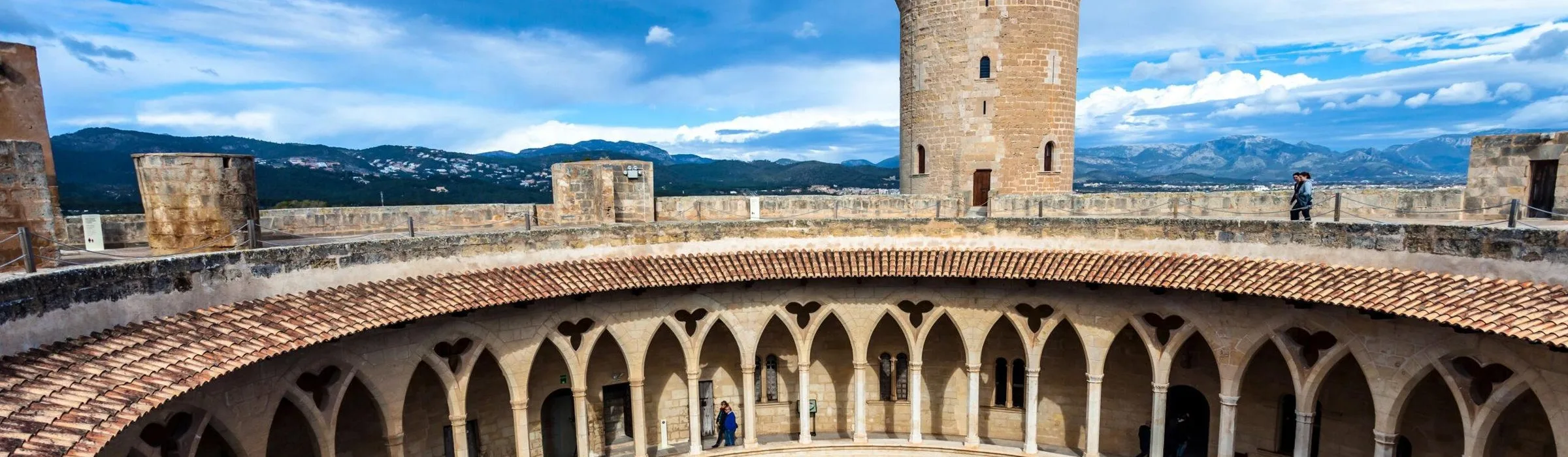
Bellver Castle is a round Gothic castle built for King James II of Mallorca around 1300, on a wooded hill. Kids cross the stone bridge over the moat, look up at the 33-meter keep and walk the circular courtyard. The castle also houses the city's history museum.
At the Carrer del Polvorí entrance to the forest, a wooden playground has separate areas for toddlers and older kids.
The museum sits inside the Rafa Nadal Academy complex and follows Rafael Nadal's career through his trophies, personal items and most iconic moments. Interactive exhibits bring visitors close to how professional athletes perform, and a separate gallery shows memorabilia from other sports legends.
Younger kids get Smash Kids, a play space built around trying sport hands-on. An add-on guided tour walks through the academy's high-performance training center.
Es Baluard sits on the Sant Pere bastion, part of the Renaissance walls that ringed Palma until the early 20th century. Inside are changing exhibitions of modern and contemporary art alongside the museum's own collection.
Outside, kids can cross the central courtyard, look out from the open-air Mirador over the Cathedral and the seafront, and spot sculptures placed around the grounds. Family workshops tie into the current exhibitions.
The foundation sits in Cala Major, where Joan Miró lived and worked from 1956 to 1983. Kids can step inside the Sert Studio, the bright workspace where he painted many canvases at once, and see the charcoal drawings he left on the walls of Son Boter, an 18th-century farmhouse.
The Moneo Building holds the collection and changing shows, and a sculpture garden with a café links it all.
InRock is an indoor climbing center with more than 60 roped routes up a 14-meter wall, auto-belay lines for climbing without a partner, and over 120 boulder problems above padded crash mats.
Younger climbers get El Castell, a separate kids' zone with up to 10 auto-belay routes, plus a Baby Rock area for toddlers. New routes go up every week, and there is a café and bar on site.
Sa Calobra is a small port on Mallorca's northwest coast where the Torrent de Pareis, the largest karst canyon in the Balearics, meets the sea. A path through tunnels cut in the rock leads from the port to a pebble beach at the gorge mouth, between the canyon's high walls.
A second pebble cove sits right at the port, beside a few bars and restaurants.
A 14-lane bowling alley on Brunswick lanes, with balls in every weight plus bumper rails and ball ramps that staff set up for small kids. Between games there is an arcade with basketball, air hockey, a dance machine and video games, along with foosball and pool tables. A café serves burgers while you wait for a lane, and the venue hosts kids' birthday parties.
Indoorwall Mallorca is a climbing gym with bouldering walls, roped lead routes, auto-belay lines and a separate kids zone. Harnesses and climbing shoes can be rented for the day, and a restaurant and cafeteria sit on site.
Kids from 4 can join the weekly climbing school, which teaches technique through games. The center also hosts climbing birthday parties and three-hour Ludokids sessions.
Neules are cut-paper Christmas decorations, one of the most traditional holiday decorations in Mallorca. At this library workshop, kids learn to fold and cut paper into their own neules, then take them home to decorate the house for the holidays.
Each child comes with an adult, so it works as a hands-on craft session you do together.
A family workshop at CaixaForum Palma about how sound travels. Kids try experiments to find out what carries a sound from one place to another.
It suits curious kids who like to test things and ask why.
A children's musical based on Charles Dickens' Christmas Carol, with Santa Claus at the center of the story. Five actors perform original songs and choreography. It is led in Catalan, and the music and dancing carry much of the story. Best for kids who like singing and can sit through a stage show.
Planets and Stars is a family astronomy workshop at CaixaForum Palma about the planets and the stars. It's an indoor session.
A musical version of the classic fairy tale, staged by La Roda Produccions. Lost in a dark, gloomy forest, Hansel and Gretel set off to find their way home, until a light leads them to a magic little house made of sweets and chocolate, where a wicked witch lives.
With a cast of five actors, it suits kids who can follow a sung story and handle a proper villain.