
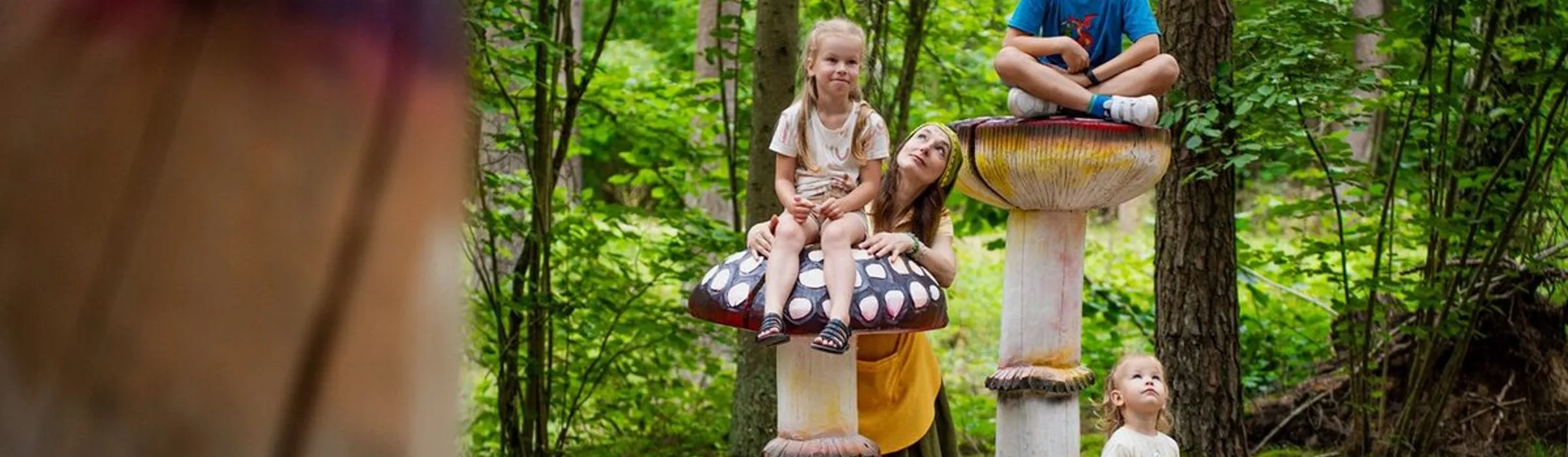
A puppet show called "Pēc līdakas pavēles" (By the Pike's Command), staged by the puppet theater Ciemos pie pasaciņas. The theater is run by an association of the same name.
It suits kids who can sit through and follow a spoken play.

Four to seven is the age when a kid will sit through a whole puppet show, then race you to the nearest playground. This list keeps to plans listed for that age: children's theater and circus, hands-on museums, parks, play cafés, mini zoos and easy day trips out of town. Shows often run in Latvian, so check each listing's language. It updates as new plans come in.
A puppet show called "Pēc līdakas pavēles" (By the Pike's Command), staged by the puppet theater Ciemos pie pasaciņas. The theater is run by an association of the same name.
It suits kids who can sit through and follow a spoken play.
A puppet show about Pif, a good-natured dog, and Hercules, a sly cat, whose squabbles fill two acts. It has played at the Latvian Puppet Theater since 1983, the oldest show in the repertoire of any Latvian theater.
Ivars Vīgners' songs became Latvian children's classics. It suits preschoolers who like bright, musical shows more than a tight plot.
A musical puppet show based on Indra Sproģe's book Joka pēc alfabēts and its silly characters: a round apple frying slippers for a pear, an eagle in a fir tree photographing a family of snails.
The songs carry it more than a story does, so it suits kids who like to sing along and are starting to learn their letters.
A stage version of the children's book and animated film about Lotte, a lively dog girl in a village of inventors. Over one summer she learns judo, takes on electricity and tests her courage.
It's a warm family play about trust and about parents learning to let kids go their own way. Kids who already know Lotte from the books or the film get the most from it.
Charles Perrault's Cinderella told with classic puppets: the fairy godmother, the wicked stepmother, a rat turned into a coachman and a pumpkin into a carriage. The puppets are modeled on the ones from the theater's first Cinderella production.
It's a traditional telling with songs, in two acts. A good fit for kids who already know and like the fairy tale.
Sarkanmatīte was once a child's favorite toy, until she wore out and was forgotten in the attic. This puppet show, based on Margarita Stāraste's fairy tale, asks whether an old, broken toy can have a second life.
Three gnome toymakers at a busy Christmas market tell her story with objects, puppets and music, from the day she was made to her unexpected chance to come back.
Jūlijonkuliņš is sure Christmas is the best holiday of the year, and that it can't happen without giving gifts (and getting them). This year he is extra cheerful: his Christmas surprise is on its way from the far-off Nordic countries.
A two-act Christmas show at the Latvian Puppet Theater, with Epentālers the cat and a flamingo along for the story. What will the surprise be?
Every year the elves Tirkšķis, Tarkšķis and Svilpīte help Santa wrap presents, but this year he isn't in the workshop. Instead they get a special job: telling children a fairy tale. They tell it and act it out as best they can, and it turns out to be harder than it looks.
A musical based on a Latvian folk tale, with an original score by Mikus Frišfelds.
A classic rod-puppet staging of Hans Christian Andersen's fairy tale. Gerda sets off to find her friend Kai, lured away by the Snow Queen, and travels from home to the ice kingdom and back.
Dark and dangerous moments are balanced by playful comic characters, from a court crow to a band of robbers. It's told in Latvian with songs, so it suits kids who follow Latvian or know the tale.
Little frog Žeroms can't fall asleep in his own bed. Strange noises in the dark keep going skrib, skrab, tweet, plunk, so he runs to Mom and Dad. This time Dad helps him find out what is making the sounds.
The Latvian Puppet Theater's show is based on Kitija Krauzere's popular book. It suits toddlers and preschoolers in the own-bed stage, and their tired parents.
A family-run home zoo near Riga, open since 2013. Fallow deer and muntjac share the grounds with llamas, alpacas, Shetland ponies, a donkey, Dutch dwarf goats, Heidschnucke sheep, emus, rheas, peacocks, skunks and peccaries.
Kids can feed the animals with carrots or pellets sold on site. There's a playground, picnic spots with and without shelters, and garden grills.
The Latvian Puppet Theater teams up with Brain Games to open its foyer for a family board game session. Kids and parents play board games, try some of the newest games, and a host explains the rules so nobody has to puzzle over a rulebook.
It suits kids who can sit through a game and take turns, and parents who'd rather play alongside them than watch.
Putnu opera is a family opera by Jānis Lūsēns and Māra Zālīte. Doctor Dolittle and his animal friends track down a missing canary, put out a fire and stage an opera of their own, with a cast of colorful birds and animals.
One of the Latvian National Opera's most popular productions, it is sung in Latvian, so it suits kids who follow the language or know the story.
LIDO Leisure Centre is a restaurant complex inside one of the largest log buildings in Europe, built from Latvian spruce more than 100 years old. Its three floors seat 1,000 people across a bistro, a restaurant and a beer cellar, with a bakery counter and live music.
The grounds cover almost 5 hectares and include an amusement park with rides for kids, open in season on shorter hours than the restaurant. The outdoor ice rink was closed for the 2024/25 season and no later season is published, so count on the restaurant in winter and call ahead before planning around the rides.
BimBom is a children's café, a bērnu kafejnīca in Latvian, built around a netted indoor play frame painted in glow-in-the-dark colors under a UV-lit ceiling. Parents can sit at the café while kids climb and play.
The café also hosts neon parties for kids, with party hosts and a neon ribbon show.
Aunt Dill is no ordinary aunt: she writes new poems every day and wants to share them with everyone, even when people run off and call the police. Kārlis Vērdiņš's rhyming verse drives this Latvian Puppet Theater play.
It's played in Latvian and the words carry the story, so it suits kids who follow Latvian well. One parent found it as interesting for herself as for her kids.
Wilhelm Busch's two famous pranksters are grown up now and a little wiser, and they agree to tell the audience the seven strangest episodes of their lives, consequences included. Two actors play Max, Moritz and the other characters.
It's a funny, musical show in Latvian. The story keeps Busch's dark slapstick, so it suits kids who enjoy cheeky mischief more than gentle fairy tales.
Ebe, a small forest spirit, moves into a new forest with best friend the Green Crow just before Christmas. The animals there are the sportiest around, always training for the Olympic Games, and have never heard of Christmas.
Ebe also hides a fear of people: forest spirits believe a human's glance makes them vanish forever. A puppet show about friendship and sharing a holiday.
Pēc eglītes! is a Christmas concert show from Latvijas Leļļu teātris. A group of brothers and sisters remember the year they went into the forest for a Christmas tree, carrying treats for the animals, and met gnomes, Mežavecis (the old man of the forest) and other characters from Latvian Christmas songs.
Four actors sing the story through. It suits kids who follow Latvian and like a singalong.
The Snow Queen, told for the very youngest as a musical fairy tale. A storyteller guides the story while singers bring it to life: Gerda sets out to rescue Kai from the Snow Queen's ice kingdom, helped by the Robber Girl and the Reindeer, and in the end good beats evil.
A circus show built around one long Christmas table and a family that can't sit still. Performers hang from the ceiling, spin around the room and juggle whatever is at hand, with slapstick and a magic tablecloth along the way.
British director Jason Dupree and choreographer Alise Bokaldere created it, with a cast of Baltic circus artists: a clown, jugglers, acrobats and aerialists.
Jelgava's international ice sculpture festival fills Pasta Island with sculptures carved from blocks of ice by artists from around the world. This is the festival's 28th edition, and the 2027 theme is "World Carnival": masks, dance, music and legends, frozen in ice.
Vērmanes Garden is the city's second oldest public park, about five hectares of shaded avenues, flowerbeds and lawns between Tērbatas, Elizabetes, Krišjāņa Barona and Merķeļa streets. Kids head for the playground, the four-season fountain and the stone lions.
The wooden open-air stage draws chess players and hosts occasional concerts and dance shows, and in the darkest weeks of the year the park fills with light strings, music and giant snowmen.
A charity-run animal shelter with about 3.5 hectares of enclosures beside the Ķekaviņa stream. Many residents were rescued from circuses or homes that couldn't keep them: wolves, a lynx, a monkey, dingoes, alpacas, a guanaco, ponies, donkeys and rabbits, plus pheasants, ducks and geese.
Kids can feed and touch some animals with food sold on site, then walk the riverside nature trails. Many animals sleep through winter.
Kids Time is a 1,000 m² soft-floor play complex on the second floor, with an active play zone for running and climbing and a photo corner.
Four private themed party rooms, each with its own kitchen, host birthdays and christenings, and guests move on to the play area after the cake. Parties can add a hands-on workshop such as cotton candy, soap or chocolate making.
Housed in the former St George's Church, the oldest surviving stone building in the city, first recorded in 1209. Two floors trace Latvian ceramics, porcelain, textiles and design from the late 19th century to today.
On the third floor, the award-winning Design Studio for Children lets kids try ceramics, kinetics, weaving and poster design, with stories told by an interactive loudspeaker called Babbit.
The Castle of Light, designed by Latvian-American architect Gunnar Birkerts, is open to walk-in visitors from Level 1 to Level 12, no reader card needed. Kids can go up to the observation deck on Levels 11 and 12 for a Riga panorama, browse the People's Bookshelf of more than 8,000 donated books in over 50 languages, and read in the Children's Literature Centre on Level 7.
Latvia's national puppet theater traces its roots to a troupe formed in 1942. Professional puppeteers stage Latvian and world fairy tales, classics and new children's books across a main hall, a small hall and a chamber hall.
Each show carries its own age mark, from picture-book stories for preschoolers to evening plays for teens and adults. A changing exhibition opens an hour before performances, and there is a cafe.
A museum of Latvian firefighting inside an Art Nouveau fire station topped by a tall hose-drying tower. One floor traces the early days with helmets, uniforms, hoses, pumps and a vintage Chevrolet Six fire engine. The other covers firefighting up to today, fire sports and the country's biggest fires, with a hall naming firefighters who died on duty. Visitors can practice putting out a fire and take part in quizzes.
A railway museum in a former locomotive repair shop, run by the national rail company. The yard outside holds the largest collection of wide-gauge rolling stock in the Baltics: steam and diesel locomotives, an ER2 electric train and wagons.
Indoors, more than a thousand objects trace the history of Latvia's railways, from uniforms and tickets to old timetables. The museum also has a resident cat named Pearl.
Six floors of a historic building hold 13 permanent exhibitions, from minerals and the geology of Latvia to insects, sea life, and Latvian birds and mammals. The Skeletarium on the 5th floor shows nearly 300 skeletons, including a Bactrian camel, a Galápagos tortoise and a fin whale vertebra.
Many halls have hands-on objects and interactive games. Labels are mostly in Latvian, with printed English guides in most halls. The museum is closed every Monday and Tuesday.
Dzegužkalns is a wooded sand dune of about 10 hectares, and at 28 meters above sea level it is the city's highest natural hill. Winding paths, stairs and slopes climb between old trees to the top, and an open-air stage sits on the slope below.
The park was laid out from 1893, and the hill has hosted Midsummer (Jāņi) celebrations since the 18th century.
Grīziņkalns covers 10 hectares on one of the highest sand dunes in the area, with paved paths and stairways up to the top. A 2015 renovation rebuilt and enlarged the children's playground, restored the wading pool, and added an outdoor gym, a dog exercise area and public toilets.
The park also has an open-air stage and a monument to the 1905 revolution, when more than 100,000 people rallied here.
Ziedoņdārzs is a park hidden behind apartment blocks on the edge of the center, between the Avoti and Grīziņkalns neighborhoods. A central alley of Dutch linden trees leads to the restored fountain with its frog sculptures.
There is a children's playground, and the layout keeps active recreation apart from quiet seating areas. Laid out in 1939, the park has since been fully renovated.
The playground fills 7,000 square meters of the Centre Sports Quarter, a fenced sports park built on the old University of Latvia stadium. Its slides and climbing pathways are split into one zone for kids up to 7 and another for kids 8 and up.
Around it are a skatepark, a pump track, an outdoor gym, a football field, and basketball and beach volleyball courts.
The University of Latvia's botanical garden covers about 10 hectares, with an arboretum, rhododendron and dahlia beds, water pools and lawns where walking on the grass is allowed. The central garden and paths are open now. The tropical greenhouse has been closed since the August 2026 storm, and the Tropical Butterfly House is a spring-to-fall attraction, closed December to March, so the free-flying butterflies return in spring.
The garden's greenhouses hold about 1,640 plant species, including a 24-meter Palm House with date palms and lemon trees, which reopened in December 2025.
An Old Town townhouse turned into a hands-on exhibition on Latvian writers and composers, laid out like a book you walk through. Kids start in the brick basement Prologue: they play instruments, build a poem from magnetic word cards and listen to it, step in as conductor, and find which Latvian book character they resemble.
Upstairs, nine sections follow 98 writers and musicians through their hobbies and habits.
Latvia's national art museum fills a historicist building on the boulevard ring with Latvian painting, graphic art and sculpture from the late 18th century to the mid-20th century. It was the first building in the Baltics designed as an art museum.
At the information point, families with preschoolers can borrow a free Family Pack: touchable prints of Purvītis paintings, a silhouette puzzle and stone samples to match to sculptures.
A play center inside K3 Mall of Imanta where one entry ticket covers a trampoline zone, a kids' play town with slides, a play area, the interactive Valo Jump and fun bikes.
Electric bumper cars with rubber bumpers all round take up to six cars at a time. Two levers drive, brake and turn each car, so first-timers manage fine.
Built in 1888, Rīgas cirks is the only permanent circus building in the Baltics. A recent renovation rebuilt the arena and strengthened the walls, keeping the historic dome frame made of old railway tracks.
The program is contemporary circus from Latvia and abroad, mixed with dance and theater. Some shows are made for families and others for adults, so it suits kids best when you pick from the family listings.
Riga Motor Museum holds the largest collection of vintage vehicles in the Baltic states: more than 100 cars and motorcycles across three floors. The ground floor tells the story of the automobile and of cars built in Latvia, the upper floor covers motorsports and Soviet leaders' state cars, and the basement holds fire trucks, ambulances and other special vehicles. Interactive multimedia displays run throughout.
Tchaikovsky's Christmas ballet. On Christmas Eve, Maria gets a Nutcracker from the mysterious Drosselmeyer, the toys under the tree come to life, an army of mice invades, and the Nutcracker turns into a prince who leads her to a fairy-tale land.
The story is told entirely in dance and music, so it suits school-age kids who can sit through a full-length show.
A stage version of Anete Melece's picture book Kiosks. Olga runs a kiosk and helps every customer at her window, but fear of the outside world keeps her inside, far from her dream of the sea. A traveler named Anton keeps challenging her to step out.
Two actors carry the show, one as Olga and one as Anton and all her customers. The humor works for kids and adults.
Erich Kästner's classic detective story, staged as a musical in a live comic-book style. After Emil's money is stolen, he teams up in Berlin with Gustav and his friends to tail a suspicious man in a bowler hat.
Actors play the kids while the grown-ups appear as large cardboard puppets, with musicians on stage. It is in Latvian, so it suits kids who follow the language.
A small sandy stretch on the Daugava, across the Vanšu Bridge from the Old Town, with a panoramic view of the Old Town skyline. It is open for walks all year. It is also one of the city's official swimming spots, but swimming is for the bathing season only (in 2026, 19 May to 15 September). There are changing cabins, boardwalks and benches.
Expect beach volleyball and a social crowd of students rather than a quiet retreat. It suits families who want a quick dip between sightseeing stops in summer.
The park covers old pine forest on the coastal dunes, including Ragakāpa itself, a 17-meter dune protected since 1962. A 2 km trail, mostly wooden boardwalk with stairs on the steepest stretches, winds through the pines past benches and boards on plants and the tracks insects leave.
Near the Jūrmala Open-Air Museum, stairs lead to a second 800 m trail that runs to the Gulf of Riga shore.
Lucavsala is a 150-hectare island in the Daugava River, open for walks and play all year, with lots of playgrounds, a volleyball court and outdoor exercise areas. Its official bathing spot is for summer only (in 2026 the Riga season ran 19 May to 15 September), and the gently sloping riverbed makes wading in easy.
The beach has changing cabins, free toilets and a swing for people with limited mobility, and a pizzeria opens in summer.
Latvia's national opera and ballet companies perform in this 1863 theater beside the city canal, with 933 seats in the main hall and a 300-seat New Hall in the modern annex.
Alongside the evening repertoire, the season includes family ballets such as The Nutcracker and The Jungle Book, plus short concerts for babies. Backstage tours take visitors onto the stage and, when free, into the rehearsal rooms.
MaryMaris is an indoor play center inside the Akropole Riga mall, with a giant maze, colorful climbing nets, a ball pit, trampolines, a ninja obstacle course, a tubing slide, a zipline and a free fall tower. There are also sports arcade machines, party houses for birthdays, and a restaurant on site.
ADVENTICA is an indoor play park on the second floor of Olimpia shopping center. Kids run a two-level play maze with slides, jump on trampolines, tackle a 60-meter ninja course with 10 obstacles, and scale a rock climbing wall.
A giant inflatable playground fills a space the size of a sports hall, and toddlers have their own corner near the parents' rest area.
Līvu Akvaparks is one of the largest water parks in Northern Europe, with more than 20 slides and 10 pools across 18,000 square meters. Thrill-seekers get the Tornado, a pitch-dark Black Slide and a diving pool that drops from the third floor to the second.
Younger kids have Captain Kid's Land, shallow 60 and 90cm pools with slides and fountains, a wave pool and the slow Orinoko river.
Tehnoannas Pagrabi (the Cellars of TechnoAnn) is one of the smallest science centers in the world, set in a cellar and filled with handmade exhibits that mix art, science and toys.
Each visit runs as a guided session, a bit like a show: hands-on exhibits about the senses, a trip to the stars in the planetarium, a maze to find your way out of, and a chemistry amphitheater.
An 87-hectare outdoor museum in a pine forest beside Lake Jugla, founded in 1924. Historic buildings moved here from Latvia's four regions (Kurzeme, Zemgale, Vidzeme and Latgale) stand furnished as they were: farmsteads, craftsmen's workshops, windmills, forges, and pottery and tar kilns.
Kids can roam the forest paths between farmhouses, step inside the homes open that day, and picnic in the Lake Meadow by the Kurzeme fishermen's village.
Riga Zoo covers 16 hectares next to Mežaparks park and Lake Ķīšezers, with nearly 500 species. The African Savannah, opened in 2019, has zebras, impalas, elands and geladas beside the giraffe house.
Indoor exhibits and a Tropical House keep part of the visit under a roof, which helps in the Latvian winter. The zoo also streams live webcams of its lions, lemurs and sloths.