
Autumn Leaves in Tokyo with Kids
CollectionSome free

Autumn Leaves in Tokyo with Kids

6 events · 7 places

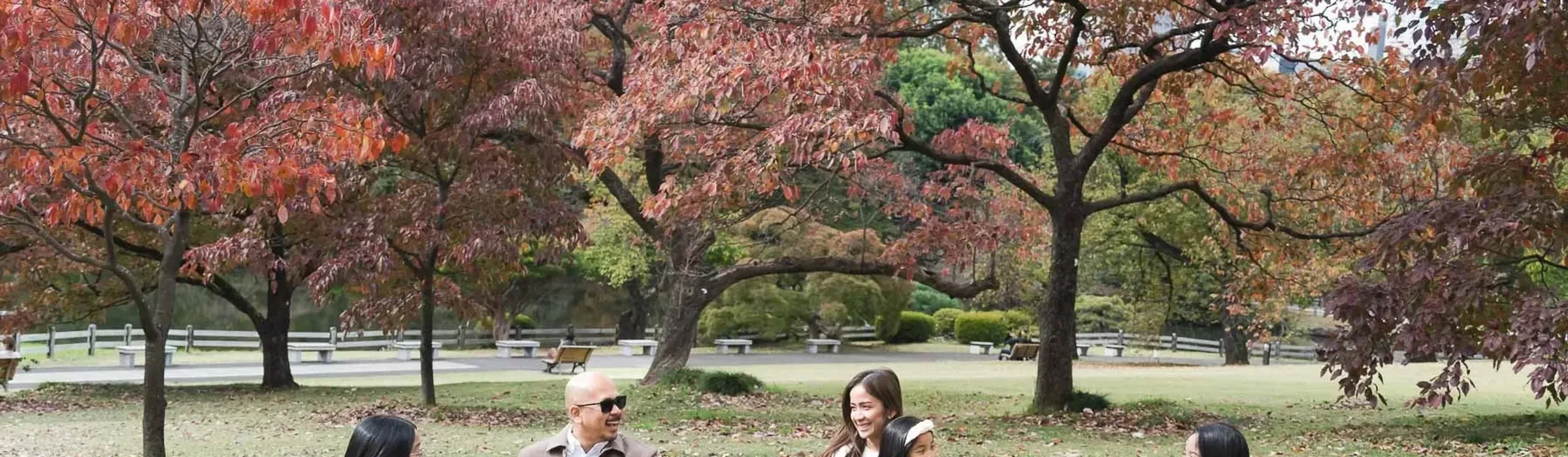
From late October the maples start to turn red and the ginkgo avenues go gold, peaking in late November. Koyo, going out to look at autumn leaves, is a family outing here, with festivals, a ginkgo stamp hunt and evening light-ups kids can stay up for. Here's what we checked, from the night walk at Showa Kinen Park to the cable car up Mount Takao.

Share with another parent

What’s in this collection

13 items
Outdoors
Where
Midorichō
When
Through Nov 29
Ages
All ages
Cost
From ¥450

Showa Kinen Park in Tachikawa lights up its autumn trees after dark. The Katarai ginkgo avenue becomes a golden tunnel with lights that change in time to music, and at the Canal two rows of ginkgo glow over a water channel and fountains.

The Japanese garden is lit too, with lanterns, wind chimes and Japanese umbrellas around its pond. Families can collect digital stamps there on the park's app.

Read More →
Park
Where
Midorichō
Cost
Kids free, adults ¥450

A 180-hectare national park on a former US airfield. The Children's Forest is the draw for families: a white bouncing dome, Japan's largest hammock, roller slides, a fog forest and a woodcraft workshop.

Beyond it are rowing boats on the Waterbird Pond, a cycling center that rents kids' bikes, and Minna no Harappa, a wide open lawn.

Read More →
Outdoors
Where
Honkomagome
When
Through Dec 6
Ages
All ages
Cost
From ¥1,000

Rikugien is an Edo-period stroll garden in Komagome, built by a feudal lord and usually closed after dark. For the autumn light-up it reopens at night, with the leaves lit across the garden and new projection mapping on an old storehouse wall and in the bamboo grove.

Kids follow the paths past photo spots and projections. Best for kids happy with a slow walk on uneven paths after dark.

Read More →
Garden
Where
Honkomagome
Cost
Kids free, adults ¥300

Rikugien is a strolling garden laid out from 1695 by Yanagisawa Yoshiyasu, an adviser to the shogun, around a wide pond with a wooded island. Paths loop past stone and earthen bridges, a man-made hill, a waterfall in the trees and old teahouses, recreating 88 scenes from Japanese poetry.

A weeping cherry blooms by the inner gate in late March, and the maples turn red in late November.

Read More →
Festival
Where
Kasumigaokamachi
When
Through Nov 29
Ages
All ages
Cost
Free

At the end of fall each year, the ginkgo trees lining Icho Namiki avenue in the outer gardens of Meiji Jingu Shrine turn a brilliant yellow, and in the evening the avenue is lit up.

It is a free stroll under the trees, not a show, so kids set the pace. It suits any age, and nobody needs any Japanese to enjoy it.

Read More →
Garden
Where
Kōraku
Cost
Primary & under free, ¥300

Koishikawa Korakuen is an Edo-period garden laid out for a branch of the Tokugawa family. Paths loop around a central pond and over hills, past a rice paddy, a weeping cherry and the Full Moon Bridge, whose reflection completes a circle in the water.

Some corners copy Chinese scenery, including a version of China's West Lake. It suits kids who like to wander, less so ones who need to run.

Read More →
Outdoors
Where
Mejiro
When
Through Dec 6
Ages
All ages
Cost
Adults ¥500, elementary ¥300

Toshima City's Mejiro Garden lights up its autumn trees after dark. The colored leaves glow under the lights, and the pond shows them upside down, a view known in Japanese as "sakasa momiji."

It's a quiet, slow walk through Japanese-style decorations and light, more for gazing than running around. Kids who enjoy night walks and pretty lights will like it; a toddler who wants to play may get restless.

Read More →
Garden
Where
Naitōmachi
Cost
Kids 15 and under free

A former imperial garden over 58 hectares, with three styles side by side: a formal garden with a sycamore-lined avenue, a landscape garden with a wide lawn under tulip trees, and a Japanese traditional garden with ponds and a tea house.

Kids can play with a rubber ball in the Kid's Area, then explore the Mother and Child Woods, where a rest house has nature picture books and hands-on exhibits.

Read More →
Festival
Where
Nozutamachi
When
Through Nov 29
Ages
All ages
Cost
Free

An autumn festival around Yakushi Pond, a park in Machida where the trees turn red, orange and yellow. During the light-up weeks, the leaves glow after dark, and a mist "cloud sea" drifts among the leaves every hour.

Kids can watch the mist come in, wander under the colored trees, and grab a snack from the food trucks. It suits families happy with an unhurried stroll.

Read More →
Mountain
Where
Takaomachi
Cost
Cable car from ¥250

Mount Takao is a 599-meter forested peak inside Meiji no Mori Takao Quasi-National Park. A cable car on Japan's steepest cable car track and a two-seat chairlift both run from the foot to about 472 meters. From the top stations, Trail 1 continues to the summit, where clear days bring views of Mount Fuji. Six nature trails carry signboards on the mountain's animals, plants, insects and birds.

Read More →
Outdoors
Where
Hongō
When
Through Nov 29
Ages
All ages
Cost
Free

Three universities on Hongo-dori (the University of Tokyo, Toyo Gakuen and Bunkyo Gakuin) team up for a walking stamp hunt under the golden ginkgo trees. Kids scan QR codes on a phone to collect digital stamps at campus and town spots, answer quizzes and level up a certificate.

On the main day each campus runs family programs, from a mini zoo and a kids' concert to disaster-prep games and crafts.

Read More →
Shrine
Where
Yoyogikamizonochō
Cost
Free

Meiji Jingu is a Shinto shrine inside a 70-hectare forest, planted in 1920 by 110,000 volunteers with trees donated from all over Japan. Forest paths lead under wooden torii gates and past a wall of sake barrels to the main sanctuary, where families rinse their hands at the purification font and kids can read the ema tablets hung with wishes.

The Inner Garden has a pond and irises in June.

Read More →
Garden
Where
Hamarikyūteien
Cost
Kids free, adults ¥300

A former shogun's garden whose pond is the only seawater pond left in Tokyo. A sluice gate lets the tide in and out, and mullet, sea bass, gobies and eels live in it. A 118m cypress bridge crosses to the Nakajima teahouse on an island.

Kids can find the 300-year pine, follow the narrow channels of two old duck-hunting sites, and see peonies in spring and cosmos in fall.

Read More →