
Exhibition
Where
Kreis 11
When
Through Nov 20
Ages
All ages
Cost
Free
The PBZ Express is an exhibition at PBZ Affoltern. It needs no German, so it works for any family.
Swiss prices add up fast, so we keep a running list of plans that cost nothing at the door. Parks with water play and big climbing frames, neighborhood parades, seasonal markets and street festivals all make the cut. Entry is free; markets and fairs often sell food or rides inside, so bring a few francs for treats.
The PBZ Express is an exhibition at PBZ Affoltern. It needs no German, so it works for any family.
A church orchestra from Schwamendingen and the puppet theater Figurentheater Ariella Dainesi team up at the Affoltern library for a family concert built around the picture book «Adam und seine Tuba».
It is told in German, so it suits kids who can follow a story in German.
Each fall, Richterswil on Lake Zurich carves about 30 metric tons of turnips into lanterns, and its old village center glows by candlelight. Brass bands play on the squares while families wander between market stalls.
The highlight is the evening parade, when local schools and clubs carry dozens of glowing turnip sculptures through the streets. It suits kids happy to stay out on a cold, dark evening.
Tschüss, Papagei! is a story play with live musicians. Tim, an animal researcher at Zoo Zürich, loses his parrot Einstein after an experiment goes wrong, and only feathers are left in his lab. His friend Mara, a detective who tracks down lost things, joins the search, and the clues send them traveling through space and time.
It suits kids who can follow a spoken story in Swiss German.
Bellevue Noël is a Christmas market on Sechseläutenplatz, between the opera house and the lake, with more than 100 food and gift stalls, music and a fondue chalet upstairs.
Kids head for their own area of small houses, with crafts, painting, a carousel and a kids' bar. At the center stands a walk-in Advent wreath with a view over the market and the lake.
Every Advent, the Weihnachtsmarkt Dörfli fills the lanes and squares of Zurich's Niederdorf with about 70 decorated market huts and festive lights. Kids can dip their own colored candles at the Märlibaracke, watch the Fortuna Fire Crew's fire shows, and snack on crêpes, churros and Dutch mini pancakes.
It is a browsing market spread through old-town lanes, so it suits families happy to wander, snack and stop for a show.
Every day of the season, choirs sing from a Christmas tree on Werdmühleplatz, just off Bahnhofstrasse. Over 40 of them take turns, each with short sets that kids can watch from start to finish.
A small regional Christmas market surrounds the tree, with a children's carousel and a fondue chalet. It's outdoors and come-and-go, so it works with a baby in a stroller as well as with older kids.
Polarzauber fills the main hall of Zurich's main station with what it bills as Switzerland's largest indoor Christmas market: craft and food stalls, mulled wine and a kids' program all season. Kids watch the Lindt Christmas train circle the big tree, dance at the kids' disco and make crafts to take home.
Being indoors makes it an easy stop on a cold day or between trains.
A Christmas market on the Münsterhof square in the Old Town, framed by the Fraumünster church and the old guild houses. The wooden stalls lean toward local shops, Zurich brands and well-made gifts, with food stands from around the world.
For kids, the draw is the culture tent, with live music and storytelling, plus a slow wander through the decorated lanes. It suits a short after-school or weekend visit.
Zurich's Samichlaus parade opens the St. Nicholas season. The Märlitram, the city's fairy-tale tram, leads richly decorated floats down Bahnhofstrasse under the Christmas lights, while many Samichläuse and their helpers, the Schmutzli, hand small gifts to children along the way.
At Bürkliplatz, the Samichlaus wraps up with a short ceremony to the sound of two brass bands. It suits preschoolers and young school kids who still believe in him.
Samichlaus is Zurich's St. Nicholas, and each Advent he and his helper Schmutzli move into a little hut in the Käferberg forest. Families follow a signposted path through the woods to find them. The pair chat with the kids and show them their Stube (living room) and bedroom.
It suits young kids who still believe in Samichlaus, and families who would rather visit him in the woods than at home.
Rapperswil's Christkindlimärt turns the medieval old town into a Christmas market. During the big market week, more than 200 stalls stretch from the lakeshore along Marktgasse to Hauptplatz, making it one of the largest in Switzerland.
It is a place to stroll, browse and look at the lights rather than a program of activities, so it suits kids happy to wander alongside a parent.
Once a year Küssnacht turns off its street lights for a St. Nicholas parade. First come up to 250 Iffelen, some over 2.5 meters tall, slipping past in silence. St. Nicholas follows with torch bearers, then about 1,100 Klausjäger swinging cowbells in time and some 200 horn players.
It is dark and loud, so it suits kids who love a spectacle more than kids who startle at noise.
Züri Carneval is Zurich's winter carnival, and this is the part built around children. Kids come in costume to a party in the festival tent on Münsterhof in the Old Town, and the next afternoon the carnival parade winds through the city center.
It suits preschool and primary-school kids who like dressing up and a lively crowd. Children who find loud, packed streets hard may prefer the tent party alone.
Sechseläuten is Zurich's spring festival, run by the city's old guilds. Kids get their own parade, with about 3,000 children in costume marching through the old town alongside young musicians. The main parade brings guild members in historic costumes and uniforms, riders, horse-drawn wagons and bands, ending at the square where the Böögg, a snowman figure, is burned on a bonfire.
It suits kids who don't mind big crowds.
About 3,000 children march through central Zurich in traditional dress and historical costumes, lined up in the order of the eras they represent, from Romanesque noblewomen to Belle Epoque and Charleston. Youth bands play along the whole route, and a wagon carrying the Böögg closes the parade.
For kids watching from the curb, it is a walking history lesson to wave at. It suits anyone fine with crowds and drums.
Knabenschiessen is a custom more than 100 years old and Zurich's biggest folk festival. Young shooters compete in a shooting contest, and the winner is crowned Schützenkönig or Schützenkönigin and paraded along Uetlibergstrasse.
For most families the draw is the Chilbi, the huge funfair that fills the grounds around it. With around 850,000 visitors, it suits kids who like a busy, loud fair.
A neighborhood park on the grounds of a former wool-dyeing works. Its landmark is a set of climbing towers with tube slides that rise into the tree canopy. A play lawn under shady trees is framed by seating steps on two sides.
Next to it sit an all-weather sports court, a bouldering wall and a rope climbing frame, plus a barbecue spot and an accessible toilet.
Locals call it the Bäcki: a 1.4-hectare neighborhood park near Langstrasse, framed by Stauffacherstrasse, Feldstrasse and Hohlstrasse. Kids head for the playground and the shallow wading pool, where splashing has been allowed since the 1939 redesign.
The Quartierzentrum Aussersihl community center stands in the park, with the Restaurant Bäckeranlage inside. On summer days the lawns fill with young families from the surrounding streets.
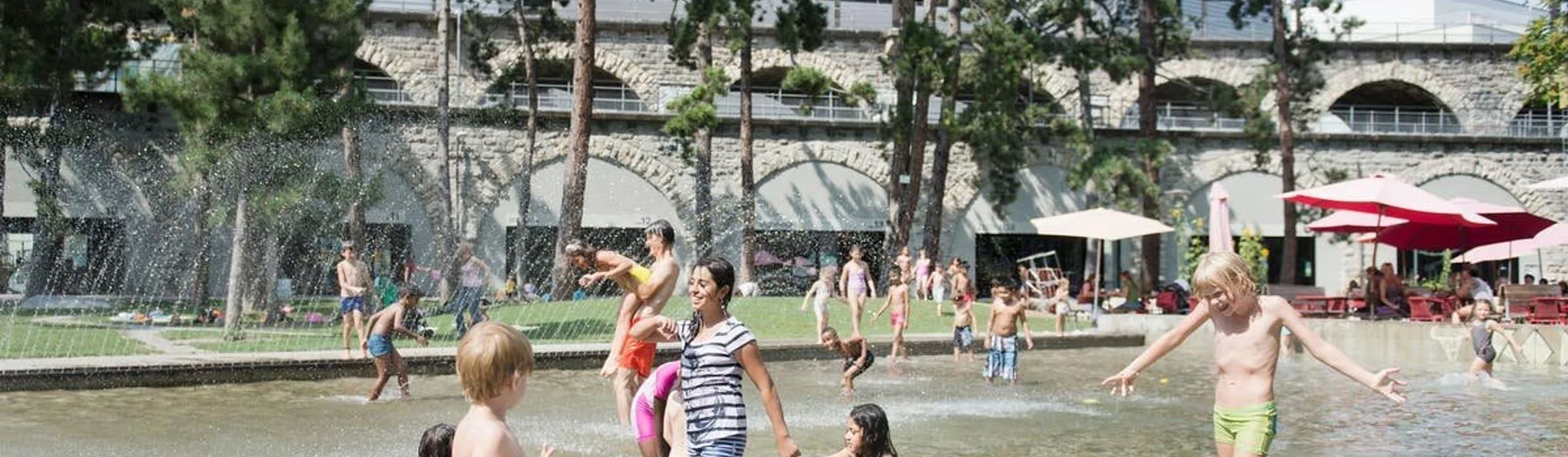
Josefwiese is a 1920s people's park beside the Viadukt arches in Zürich-West, laid out for play and sport rather than strolling. Kids get climbing frames and a paddling pool with water play.
The big lawn is for picnics, football and sunbathing, plus pétanque, table tennis, a beach volleyball court and a barbecue spot. A kiosk sells salads, grilled food and drinks.
Oerliker Park opened in 2001 on former factory land in Oerlikon. Its landmark is a blue lookout tower: a steel staircase spirals up through the treetops to a platform 35 meters up, with views toward the city center and the Uetliberg.
The park also has a large climbing frame, play equipment for small kids, a wooden deck and a long turquoise fountain with water play.
Fritschiwiese began as a cemetery in the late 19th century and became a public park in 1921, laid out together with local residents. Today it has a large play lawn, playgrounds, benches and a hilly landscape first designed as an adventure playground.
The paddling pool draws crowds on hot days, and neighbors use the open grass for picnics, games and small workouts.
Riedenholzhof is an organic family farm on city-owned land. Its herd of about 100 water buffalo, calves included, lives in a barn that visitors can walk into from the open farmyard. Dairy cows, boarding horses and, in spring and fall, a few pigs share the farm.
From about June into fall, families pick their own berries in a field by the farm shop.
Juckerhof is a working farm above Lake Pfäffikon, with a farm restaurant, a farm shop and views across the lake. Kids get a playground, a goat park, a straw bouncy castle and play tractors.
The ÖpfelGarte grows nearly 6,000 apple trees into two mazes and a labyrinth, beside a barefoot trail. Each autumn the farm fills with giant pumpkin sculptures.
GZ Bachwiesen is one of the city's community centers. Donkeys, ponies, goats, guinea pigs, rabbits and chickens live in pens that families can walk up to at any time, though visitors are asked not to feed them.
Inside, a café serves homemade cake and syrup for kids, and the wood workshop lets children build their own projects with staff showing them the machines, no course or sign-up needed.
GZ Heuried is a neighborhood community center run by the Zürcher Gemeinschaftszentren foundation. Its Erlebnisgarten (adventure garden) keeps llamas, alpacas, goats, dwarf sheep and rabbits.
Inside, the open workshop stocks soapstone, wood, fabric, plaster, paint, beads and clay, so kids can bring an idea or pick a material and start. The cafeteria welcomes families whether or not they order.
GZ Wipkingen is a city community center on a meadow beside the Limmat. Kids run the lawn, climb the rope playground, swing, and dig in a sandpit with a conveyor belt.
The Wipkihof farm keeps mini pigs, dwarf goats, guinea pigs and chickens. On open-stable afternoons kids help in the barn, feed and pet some of the animals, and usually bake stick bread over a fire.
GZ Buchegg is one of the city's community centers, a short walk over the footbridge from Bucheggplatz. Donkeys, ponies, llamas and goats live in pens that families can stop by and watch, and visitors can help with the morning feeding.
Inside there's a self-run play room, a café with homemade cake where nobody has to order, and a stage for dance and theater made for young audiences.
The University of Zurich's botanical garden spreads over 5.3 hectares of themed beds, a pond, a Mediterranean garden and an alpine rockery, plus three glasshouses with lowland rainforest, mountain rainforest and savanna plants.
For kids there's an adventure garden, tucked between the crop and medicinal plant beds, with stations on tree rings, wood weight and roots, a barefoot trail, and a covered spot with tables.
Irchelpark is a naturalistic park of about 32 hectares wrapped around the University of Zurich's Irchel campus. Paths loop past a lake with fish, ducks and herons, two streams, wildflower meadows and Monte Diggelmann, a small viewpoint hill.
Kids can play in the sand and boulder playground by the lake and follow the Irchel Nature Trail, whose 20 boards cover birds, frogs, bees and dragonflies.
Rieterpark is a 19th-century landscape garden laid out by Theodor Froebel around Villa Wesendonck, now home to Museum Rietberg. Its 6.8 hectares of wide lawns climb gently south from the villa under old trees, with views to the Glarus Alps on clear days.
Kids can run the open lawns, hunt for the bronze sculptures and the old dolphin fountain dotted through the grounds, and stop at the park's playground.
Blatterwiese, which locals call Chinawiese after the Chinese Garden next door, is a wide lawn on the shore of Lake Zurich. Its fenced playground has a large sand area, a climbing wall, swings and water fountains for hot days.
Around it, families picnic, use the public grills nearby, kick a ball or swim in the lake, and a kiosk sells ice cream and cold drinks.
Sihlwald is a beech forest along the Sihl river that has been left unmanaged since 2000, and at 970 hectares it is the largest natural forest reserve on the Swiss Central Plateau.
By the visitor center, a wilderness playground has branch nests, rope bridges, a hollow fir trunk to crawl into and a water play fountain. Fire pits and a 2.6 km forest adventure trail start there.
A ridge walk from Uetliberg to Felsenegg that maps the solar system to scale: every meter of path stands for 1 million kilometers. Kids follow it from the Sun past the eight planets to dwarf planet Pluto.
At Felsenegg the view stretches over Lake Zurich to the Alps, and the IceAgeCam next to the restaurant gives an interactive look at the same view through the ice ages.
Zurich's local mountain rises to 871 meters, with forest trails, a 70-meter observation tower at the summit (178 steps) and views over the city, the lake and, on clear days, the Alps. The Planet Trail is an easy two-hour walk to Felsenegg through a scaled-down solar system.
In winter a toboggan run drops through the forest toward Triemli, and in November the top often sits above the fog.
A 5,500 m² city-run bike park on the Allmend Brunau, just south of Sihlcity, and the biggest of Zurich's public bike facilities.
The courses come in three difficulty levels: an Urban-BMX layout with two lines from a 4-meter start hill, a jump track with curves and bowls, a pump track with waves and banked turns, and a balance-bike track with gentle waves and curves for toddlers from age 2.
A public playground at the Horn, the lakeside park where Küsnacht's Dorfbach stream runs into Lake Zurich. The centerpiece is a big green octopus that kids clamber over and slide down, with a nest swing alongside.
It suits confident climbers best. The play area sits right on the water, so toddlers need a close eye.
A supervised building playground run by the local association VAA, where kids hammer, saw and climb on wooden huts built by earlier visitors. Tools and materials are handed out free, two people to a toolbox, and staff show how to use them. Regulars can build a hut of their own. A fire is always lit for grilling, and parents can build along or sit by it.
Werdinsel is an island of about eight hectares in the Limmat, between the river and a power-station canal. Once a parking lot and a car scrapyard, it is now open lawns with a playground, a soccer field, public grill spots, a restaurant and an accessible toilet.
The Flussbad Au-Höngg river bath sits here, using the old Strickler spinning mill from 1817 as its changing rooms.
Lindenhof is a gravel square under lime trees on a moraine hill above the Old Town, with a view across the Limmat to the university buildings. People play chess under the trees, and the square hosts pétanque tournaments and theater.
It was a Roman fort from 15 BC. The fountain recalls the legend of Zurich women who, in 1292, dressed in armor to fool a Habsburg army.
Platzspitz is the wedge of parkland where the Sihl and Limmat rivers meet, next to the Swiss National Museum. Paths run under tall plane trees, some of the city's oldest, to an iron gazebo and a statue of the poet Salomon Gessner.
There is a playground and an accessible toilet, and at the northern tip two bridges cross the rivers to the neighboring quarters.
A walled Chinese temple garden on the lake's east shore by the Blatterwiese, a gift from Zurich's partner city Kunming, opened in 1994. Inside, winding paths and ornate bridges circle a pond with a small island, past pavilions, a palace, an artificial mountain and a zigzag bridge.
It's a quiet stroll, not a play space, so it suits kids happy to explore slowly.
Zürichhorn is a lakeside park on the east shore of Lake Zurich, where the wide Chinawiese lawn runs down to the water under old trees. Kids head for the big playground, hop the stepping stones across the pond, and look up at Jean Tinguely's Heureka sculpture.
The Chinese Garden and the Pavillon Le Corbusier sit at the park's edges, and lake boats stop at the Zürichhorn landing.
A city-run river bath on the Limmat, open since 1909. Strong swimmers ride the current down a 100-meter channel beside the old wooden bathhouse and climb out at a catch rail at the end.
Kids who can't swim stay on the lawn side: a non-swimmer pool, a round paddling pool with a small slide, a playground and a kiosk with food.
Seebad Katzensee is a city-run lake bath on the Katzensee, set inside a nature reserve in Affoltern. It has a large sunbathing lawn, barbecue spots, a kiosk, and a children's area with water play.
Swimming is allowed only inside the bath, since the lake and shore outside it are a protected zone. Air mattresses, rubber boats and paddleboards are banned on the whole lake.
This branch of the city's Pestalozzi-Bibliothek (PBZ) public library spreads over three floors right at Oerlikon station, with room to play, read and work. The shelves for kids hold picture books, audiobooks, children's CDs, Tonies, films and games, plus media in other languages besides German.
A changing table, a reading lounge and Wi-Fi make a longer visit easy, and the building is wheelchair accessible.
Milandia is a sports and leisure park beside a nature reserve near the old town of Greifensee. Kids get two playgrounds, one with a big tower and four slides, an 18-hole minigolf course, and a chemical-free natural pool with a paddling area.
A fitness club, climbing center, padel courts and football pitches share the site, and staff in the Kinderparadies mind small children while parents stay on site.
Wildpark Bruderhaus is a forest wildlife park on the Eschenberg, just south of Winterthur, founded in 1890 and run by the city. Around 90 animals of ten native or once-native species live in large wooded enclosures: wolves, lynx, European bison, Przewalski's horses, wild boar, red deer and mouflon.
Info boards and nature trails line the gravel paths, and there is a playground, a restaurant and picnic spots with fire pits.
Switzerland's oldest zoo, founded in 1869, is also the country's largest by area. It keeps 19 native and formerly native mammal species in large, near-natural forest enclosures: brown bears, wolves, lynx, moose, European bison, Przewalski's horses, wild boar, ibex, otters and marmots.
Between enclosures there are two playgrounds, one with swings and a zip line and a smaller one with climbing for young children.
focusTerra is the Earth and Science Discovery Center of ETH Zurich, set in a three-floor exhibition tower inside the university's NO building. The floors cover how the Earth moves, the treasures it holds and the history stored in its rocks.
Kids can try interactive exhibits and look at the Omniglobe, the Indergand Crystal, minerals, meteorites, fossils and historical reliefs of the Alps.
Opened in March 2024, the museum brings the university's zoology, paleontology, botany and anthropology collections under one roof, with more than 1,500 animals and fossils on show. A touchable, life-size Plateosaurus greets kids at the entrance, and the dinosaur rooms add tactile reconstructions.
Other rooms cover Swiss wildlife, fossils from Monte San Giorgio, Ice Age life with the Neanderthal Orsa, and how plants communicate. A cinema runs nature films.